Collaborative Flood-Prediction Work Presented at EGU 2022
Joint work by Rasheed, Aravamudan, Anagnostopoulos, and Nikolopoulos explored machine learning and satellite precipitation data for flood prediction in ungauged basins.
 Credit: Zimeena Rasheed.
May 25, 2022. Collaborative work involving MLRG members was presented at the European Geosciences Union General Assembly 2022 (EGU 2022), held in Vienna, Austria, and online during May 23–27, 2022.
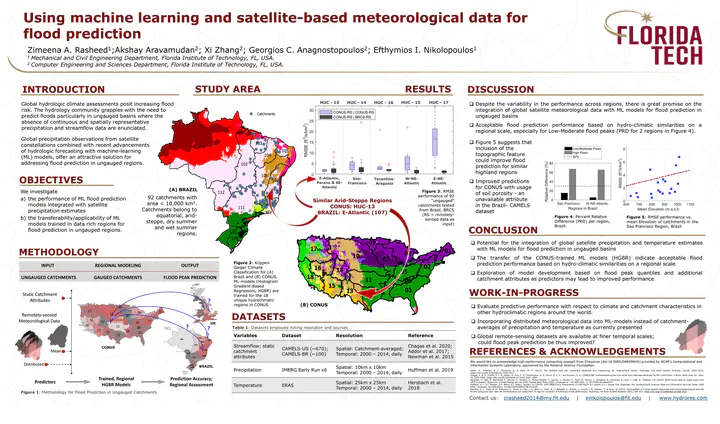
The presentation, titled “Flood prediction in ungauged basins with machine learning and satellite precipitation data,” was based on joint work by Zimeena Rasheed, Akshay Aravamudan, Xi Zhang, Georgios C. Anagnostopoulos, and Efthymios I. Nikolopoulos. The work addressed the challenge of predicting floods in ungauged basins, where limited ground-based precipitation and streamflow observations make hydrologic forecasting especially difficult.
The study investigated how machine learning models, combined with satellite precipitation estimates from NASA IMERG, can support flood prediction in regions with limited in situ observations. The team trained machine learning models using data from hundreds of catchments in the contiguous United States and evaluated their transferability to catchments in other regions, including Brazil, the United Kingdom, Chile, and Australia.
The results highlighted the promise of combining globally available satellite precipitation data with machine learning models for flood prediction in ungauged basins. This work contributed to the group’s broader research efforts at the intersection of machine learning, remote sensing, and hydrologic forecasting.
Congratulations to Zimeena and Akshay on this collaborative contribution!

Georgios C. Anagnostopoulos
Associate Professor of Electrical Engineering & Computer Science
I lead the Machine Learning Research Group at FIT.