MLRG Celebrates Dr. Xi Zhang’s Graduation!
Xi Zhang earned her Ph.D. in Electrical Engineering.
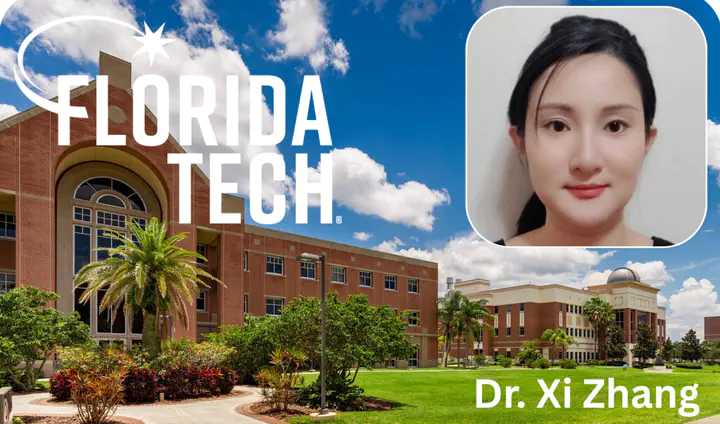
Dec 14, 2024. MLRG congratulates Dr. Xi Zhang on graduating with her Ph.D. in Electrical Engineering from Florida Tech this December.
Zhang’s dissertation, titled “Theoretical Advancements in Hawkes Processes and Their Practical Applications,” advanced the theory and use of temporal point processes, with a particular focus on Hawkes self-exciting point processes. Hawkes processes are mathematical models for events that unfold over time and can trigger additional events, making them useful for studying phenomena such as earthquake aftershocks, financial activity, neural spike trains, and information diffusion on social media.
A major contribution of Zhang’s doctoral work was a generalized time-rescaling theorem for temporal point processes. The classical time-rescaling theorem is widely used for goodness-of-fit evaluation, but it traditionally assumes non-terminating processes and complete observations. Zhang extended this framework to accommodate terminating processes and right-censored data, enabling more robust model validation in realistic settings where event sequences may be incomplete or naturally terminate.
A second contribution focused on predictive modeling with Hawkes processes. Zhang studied the first- and second-order conditional moments of counting processes associated with marked Hawkes processes and derived closed-form expressions for conditional mean and variance. These results support more accurate and efficient prediction of future event counts and motivated CASPER, a discriminative approach for anytime information cascade popularity prediction. This work has direct relevance to forecasting how widely online content may spread after only part of its diffusion history has been observed.
A third contribution introduced a nonparametric, kernel-based method for estimating Hawkes process intensity functions. By iteratively updating declustering probabilities and deriving principled kernel weights with asymptotic properties, Zhang’s approach provides a flexible and interpretable alternative to more restrictive parametric estimation methods. This contribution makes Hawkes process modeling more accessible and adaptable for analysts working with complex real-world event data.
Together, these contributions reflect Zhang’s rigorous and creative approach to temporal point process modeling. Her dissertation advanced MLRG’s research on model validation, nonparametric inference, and predictive learning for event-driven systems, while expanding the applicability of Hawkes processes to a broader range of real-world problems. Her doctoral research was supported in part by grants from NASA, DTRA, DARPA, and NSF.
It has been a privilege to witness Xi’s growth into a thoughtful, capable, and independent researcher. MLRG is proud of her accomplishments and wishes her continued success in the next stage of her career.
Congratulations, Dr. Zhang!

Georgios C. Anagnostopoulos
Associate Professor of Electrical Engineering & Computer Science
I lead the Machine Learning Research Group at FIT.