Dr. Akshay Aravamudan Graduates!
Akshay Aravamudan graduated with his Ph.D. in Computer Engineering on May 10, 2025.
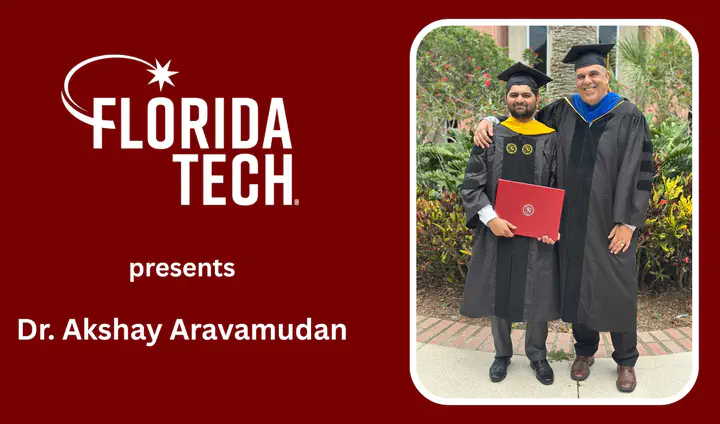 Drs. Aravamudan and Anagnostopoulos after the graduation ceremony.
May 10, 2025. MLRG congratulates Dr. Akshay Aravamudan on graduating with his Ph.D. in Computer Engineering from Florida Tech on Saturday, May 10, 2025.
Aravamudan’s dissertation, titled “Expressive and Interpretable User Engagement Prediction using Multivariate Survival Processes,” advanced machine learning methods for modeling and predicting how users engage with information as it spreads online. His work focused on building models that are not only accurate, but also interpretable, enabling researchers to better understand the dynamics that shape information diffusion in digital environments.
A central contribution of his dissertation is DANTE, a discriminative probabilistic model for anytime user engagement prediction. DANTE uses multivariate survival processes to model whether users will engage with an information cascade, such as by reacting to, sharing, or otherwise participating in the spread of online content. Unlike approaches that require separate models for different observation periods or forecast horizons, DANTE provides a single interpretable framework that can make predictions across arbitrary time windows. This makes it especially useful for settings where predictions must be updated as only partial cascade information becomes available.
Aravamudan further extended this line of work through EXPEDITE, a neural model that builds on DANTE while preserving the structure and interpretability of survival-process-based modeling. EXPEDITE uses neural architectures to learn more expressive representations of user-to-user influence while retaining the ability to reason about the mechanisms driving engagement. The work also introduces a max-hinge loss formulation designed to improve predictive performance, particularly in data-scarce settings where traditional likelihood-based approaches may be less effective.
Beyond user engagement prediction, Aravamudan also contributed to MLRG’s work on influence dynamics among online narratives. In collaboration with researchers at Florida Tech and the University of Central Florida, he used multivariate Hawkes processes to study competing narratives on Twitter during the 2019 Venezuelan Presidential Crisis. This work modeled how narratives influenced one another over time and helped identify influence patterns that aligned with major real-world political events, illustrating how interpretable point-process models can provide insight into the evolution of online discourse.
Taken together, these contributions reflect Aravamudan’s sustained effort to bridge predictive performance and interpretability in models of information diffusion. His doctoral research advanced MLRG’s broader research agenda on machine learning methods for understanding user engagement, online influence, and the complex dynamics of digital society. His work was supported in part by grants from NASA, DTRA, DARPA, and AFRL.
Akshay has begun the next chapter of his professional journey as an Applied Scientist II at Amazon. We are proud of his accomplishments and wish him continued success in his career.
Once again, congratulations, Dr. Aravamudan!

Georgios C. Anagnostopoulos
Associate Professor of Electrical Engineering & Computer Science
I lead the Machine Learning Research Group at FIT.