P-PFE
Prithvi-WxC-powered probabilistic precipitation forecasting for flood decision support.
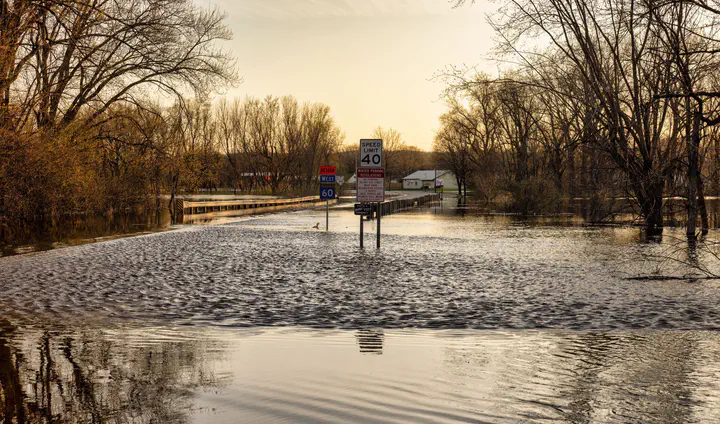
Status: Awarded.
The project was awarded in Jul 2026 and is scheduled to run from Sep 2026 through Aug 2028.
Synopsis
Reliable flood-response decisions often depend on localized precipitation extremes, where small spatial displacement errors can make the difference between an adequate warning and a damaging near-miss. In practice, emergency managers and flood-forecasting partners frequently work with deterministic precipitation guidance that does not quantify the uncertainty most relevant to evacuation timing, asset staging, and threshold-based response.
Prithvi-WxC-Powered Ensemble Precipitation Forecasts (P-PFE) is a newly awarded NASA project funded through the Applied Sciences Program and its Earth Science to Action element. The project is focused on scalable, computationally efficient generation of high-resolution probabilistic precipitation forecasts for flood decision support. It is centered on adapting the NASA/IBM Prithvi-Weather and Climate (Prithvi-WxC) foundation model to produce 50-member precipitation ensembles that better characterize uncertainty in rainfall placement and intensity than single-run forecasts alone.
The broader technical framework combines harmonized meteorological and radar-derived precipitation datasets, foundation-model adaptation, generative ensemble modeling, hydrologic-model coupling, and cloud-deployable delivery tools. The system is intended to deliver probabilistic precipitation information that can be integrated into existing flood-forecasting workflows rather than treated as a stand-alone research product.
The initial demonstration environments are in New Jersey and Iowa, where project partners will evaluate the value of ensemble precipitation information for flood-risk assessment, emergency response, and decision support. The broader project also emphasizes interoperability, cloud-ready deployment, and transition-oriented evaluation through shadow-operational testing with end users.
Within this broader effort, our group’s role centers on the machine-learning and AI methodology behind ensemble generation, including adaptation of the Prithvi-WxC backbone, development of a probabilistic generative forecasting framework, and related software support for scalable, decision-relevant precipitation prediction.
People
The broader project is led by Efthymios I. Nikolopoulos at Rutgers University.
The senior project team also includes Jie Gong from Rutgers University, Humberto J. Vergara from the University of Iowa, Timothy Mayer from the University of Alabama in Huntsville, and Georgios C. Anagnostopoulos from Florida Institute of Technology. The broader collaboration spans hydrometeorology, flood modeling, AI/ML, open-source platform development, and operational decision support.
Operational and stakeholder engagement is embedded in the project through the New Jersey Office of Emergency Management (NJOEM), the Iowa Flood Center (IFC), and local partners in Spencer, Iowa. These partners are expected to participate in co-design, shadow-operational evaluation, and transition-oriented assessment of the forecasting framework.
At Florida Tech, the project is led by Georgios C. Anagnostopoulos as institutional PI. Our group’s anticipated contributions focus on adaptation of the Prithvi-WxC backbone, probabilistic and generative machine learning for precipitation forecasting, and related software development for scalable ensemble prediction. The Florida Tech effort is also expected to support a graduate research assistant who will contribute to model development, evaluation, and project-related research workflows.
Support
Our group’s project-related efforts are supported by the following grant:
- Anagnostopoulos (Institutional PI), National Aeronautics and Space Administration (subaward from Rutgers University), Applied Sciences Program / Earth Science to Action, via A.9 “User-Centered Applications with Large Earth Foundation Models,” “Prithvi-WxC-Powered Ensemble Precipitation Forecasts (P-PFE): A Scalable and Cost-Efficient Framework for Decision Support,” 09/01/2026 – 08/31/2028.
The broader project emphasizes the use of the NASA/IBM Prithvi-WxC foundation model for downstream Earth-science applications, with a specific focus on probabilistic precipitation forecasting for flood-related decision support.
The Florida Tech effort is expected to support one graduate research assistant during the project period.
Anticipated Outcomes
At the broader project level, P-PFE is expected to deliver a prototype framework for high-resolution ensemble precipitation forecasting that can support more risk-aware flood decision support than deterministic guidance alone. A central anticipated outcome is a practical pathway for moving from single “best-guess” precipitation forecasts to probabilistic precipitation intelligence that better reflects uncertainty in storm placement and intensity.
From the machine-learning perspective, the project is expected to advance the adaptation of Earth foundation models for regional, high-impact forecasting tasks. In particular, it will explore how a Prithvi-WxC backbone can be combined with a probabilistic generative module to produce computationally efficient, decision-relevant precipitation ensembles.
At the operational level, the project is expected to support shadow-operational testing with end users in New Jersey and Iowa, including integration of precipitation ensembles into existing flood-forecasting workflows. This will help assess the practical value of probabilistic precipitation inputs for flood-risk evaluation, warning lead time, and resource-staging decisions.
The project is also expected to produce reusable software, interoperable data products, and technical documentation aligned with open-science and platform-sustainability goals. These outcomes are intended to make the framework easier to evaluate, maintain, and potentially adapt to other regions and related weather-risk applications in the future.

Georgios C. Anagnostopoulos
Associate Professor of Electrical Engineering & Computer Science
I lead the Machine Learning Research Group at FIT.